Why You Are Always Half a Beat Behind the Music in Adult Ballet
Quick Answer: Being consistently late in class is usually a processing-order problem, not a musicality one. You are decoding the steps while the music plays, so the movement can only begin after the recall finishes - which lands you a beat or half a beat behind. The fix is to move recall earlier: mark the combination with your hands during the demonstration, name the preparation count out loud, and start your breath and arm one full count before the movement. Most adults close the gap in two or three classes without any change in rhythm ability.
You can clap in time. You dance in your kitchen perfectly well. And then the pianist starts and you are permanently, mortifyingly a beat behind everyone at the barre. Almost every adult beginner assumes this means they are unmusical. It usually means something much more fixable.

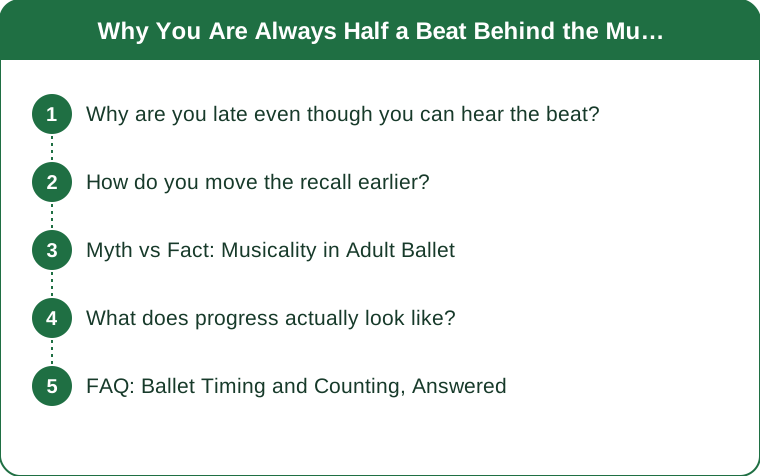
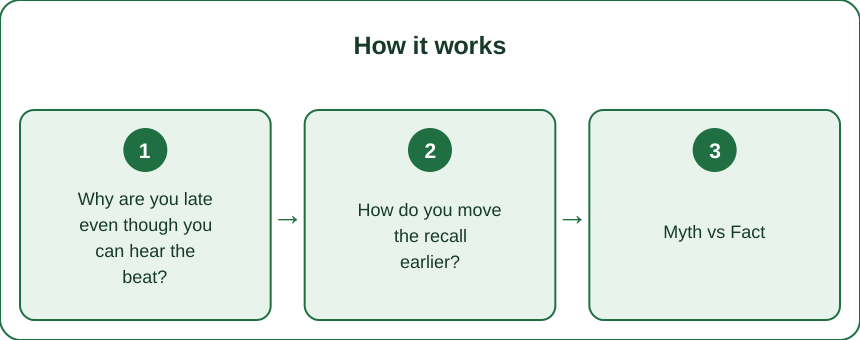
Why are you late even though you can hear the beat?
Because in class you are doing two things in sequence that dancers do in parallel. Trained dancers hold the combination in movement memory, so hearing the music triggers the body directly. Adult beginners hold the combination in verbal memory - tendu front, tendu side, close, repeat - so hearing the music triggers a recall, and only after the recall completes does the body start. That gap is the exact size of your lateness.
The recall gets slower under the specific pressure of class. Working memory is where the combination lives for the first few minutes, and working memory is degraded by exactly what class provides: novel vocabulary, mirrors, other people, and the fear of being wrong. This is why you can execute the same combination flawlessly alone at the end of class.
Preparation counts are where most of the loss happens. In ballet, the preparation is not dead time - it is where the body organizes weight, breath, and arm so that count one arrives already in motion. Adults typically spend the preparation trying to remember step one, so count one arrives and the body starts from zero.
And the correction usually offered makes it worse. Being told to listen to the music harder directs attention to the audio while the actual bottleneck is retrieval. Listening harder does not speed up recall - it just adds another thing to attend to.
The reliable diagnostic. If you are on time in the second and third repetitions of a combination but late in the first, it is retrieval, not rhythm. If you are late even in the fourth repetition of something simple, that is worth a separate look - and usually turns out to be preparation habits rather than hearing.
How do you move the recall earlier?
The goal is to finish remembering before the music starts rather than during it.
Mark with your hands during the demonstration. Not politely watching - actively tracing the combination with your fingers on the barre or in the air while the teacher shows it. This converts verbal memory into motor memory in real time, which is the whole difference between the two processing routes. It is completely normal studio behavior and nearly every experienced adult in the room is already doing it.
Say the first two steps out loud to yourself during the preparation. Not the whole combination - just the entrance. Most late starts are a failure to launch, not a failure in the middle. Once the body is moving, the rest usually follows.
Name your preparation aloud in your head as counts, not as steps. And two, three, four - breathe, arm, and go. Counting the preparation gives the entrance a runway. Adults who skip this are effectively starting from a standstill on count one every single time.
Start the arm and the breath one count early. Ballet movement is initiated before it is visible; the port de bras and the inhale lead the leg. If you time your arm to arrive with the music, the leg is inevitably behind it. Aim to have already begun.
Watch the person in front on the first repetition, then stop. Using a reference for one repetition is efficient; using one for all four prevents you from ever building your own timing, and it keeps you permanently a fraction behind whoever you are copying.

Myth vs Fact: Musicality in Adult Ballet
Myth: Being behind means you have no rhythm. Fact: Rhythm perception and movement initiation are different processes. Most adults who are late in class can clap a complex rhythm accurately - the delay lives in retrieval and preparation, not perception.
Myth: Counting out loud is a beginner crutch you should drop quickly. Fact: Professional dancers count constantly, and choreographers count relentlessly. What changes with experience is that counting becomes internal, not that it disappears.
Myth: You should listen to the melody. Fact: For timing, follow the underlying pulse - typically the bass or the left hand of the piano. Melody floats and rubatos; the pulse is what everyone else in the room is actually moving on.
Myth: If you were musical, you would not need to count the preparation. Fact: The preparation is choreographed. Skipping it is a technical omission, not a sign of natural musicality, and it is the most common single cause of late entrances at the barre.
Myth: This gets fixed by taking more classes. Fact: Volume alone entrenches whatever you are already doing. Marking during demonstrations and counting preparations changes it in a handful of classes; another year of watching the person in front changes very little.
What does progress actually look like?
First, the first repetition stops being a disaster. You will notice you enter on time on the opening repetition instead of catching up by the second. That is the retrieval work paying off, and it usually appears within two or three classes of marking during demonstrations.
Then you start hearing the music as a partner rather than a timer. Once you are not spending count one on recall, there is attention left over for the phrase - and that is where the difference between accurate and musical lives. Many adults describe this as the moment class started to feel like dancing.
Adagio gets easier before allegro does. Slow work gives you more recall time per movement, so the improvement shows there first. Fast petit allegro is the last thing to click because the retrieval window is genuinely tiny, which is why it is normal to still be scrambling there months after barre feels settled.
You will regress in new material, and that is correct. Any unfamiliar combination sends you back to verbal memory temporarily. The skill you are building is not never being late - it is recognizing the cause and reaching for marking and preparation counts automatically.
Give it a term, not a week. Adults tend to expect this to resolve in one class because the fix is simple. The fix is simple; the rewiring takes repetition. Eight to twelve classes with deliberate marking and counted preparations is a realistic window for it to feel normal.
FAQ: Ballet Timing and Counting, Answered
Why am I always a beat behind in ballet class?
Most commonly because you are recalling the combination as words while the music plays, so movement can only begin after retrieval finishes. Marking the combination with your hands during the demonstration and counting your preparation moves that work earlier and usually closes the gap.
Should I count out loud in ballet class?
Count internally during the exercise and quietly name your first two steps during the preparation. Counting is standard practice at every level - what changes with experience is that it becomes silent, not that it stops.
What should I listen to in the music - the melody or the beat?
Follow the underlying pulse, usually the pianist’s left hand. The melody stretches and breathes, and following it is a common reason adults drift ahead or behind while feeling like they are perfectly on the music.
How long does it take to stop being late?
Most adults see the first repetition improve within two or three classes of marking during demonstrations, and the habit feels natural somewhere around eight to twelve classes. Expect temporary regression whenever the material is new - that is the process working, not failing.
TL;DR:
- Being late in class is usually a retrieval problem, not a rhythm problem - you are decoding the combination while the music is already running.
- Mark the combination with your hands during the demonstration to convert verbal memory into movement memory before the music starts.
- Count the preparation deliberately and start your breath and arm one count before the leg; entrances fail at the launch, not the middle.
- Follow the pulse in the bass rather than the melody, and use the dancer in front as a reference for one repetition only.
- Expect the first repetition to improve within a few classes and the habit to settle over eight to twelve; new material always sends you back briefly.
You are not unmusical. You are doing your remembering at the exact moment everyone else is doing their dancing - move the remembering earlier and the music stops feeling like something you are chasing.
Keep Reading
This article is for general informational and styling purposes only. Fit, sizing, and product availability may vary.