Why the Second Side Feels Like a Different Body
Quick Answer: The gap between sides is mostly motor learning, not strength. Your first side gets the clean rehearsal while your brain is fresh and the teacher’s demonstration is recent; your second side gets a tired, rushed copy of a memory. Fix it by changing the order, slowing the second side down, and doing your at-home work second-side-first — not by adding conditioning.
The combination goes fine. Then you turn around, and someone has swapped your body for a similar-looking one that has never taken a ballet class.
Same legs. Same eight counts. Completely different result. And the usual explanation — that your left side is just weaker — is almost never the real story.
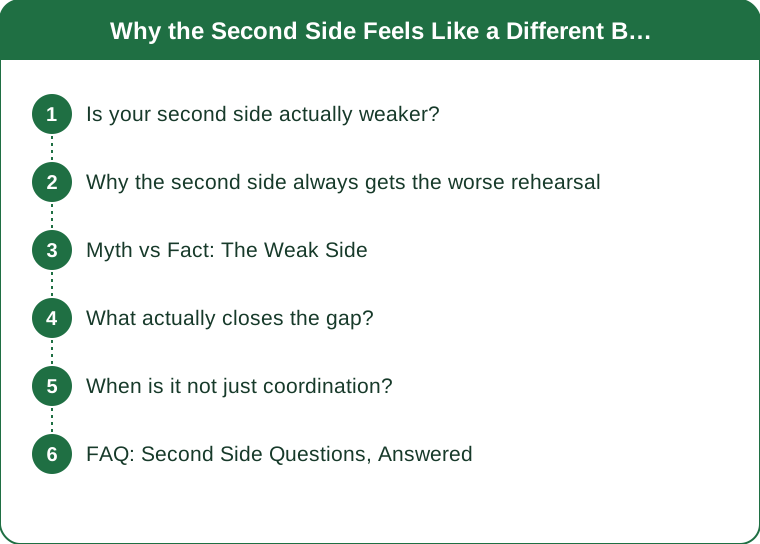
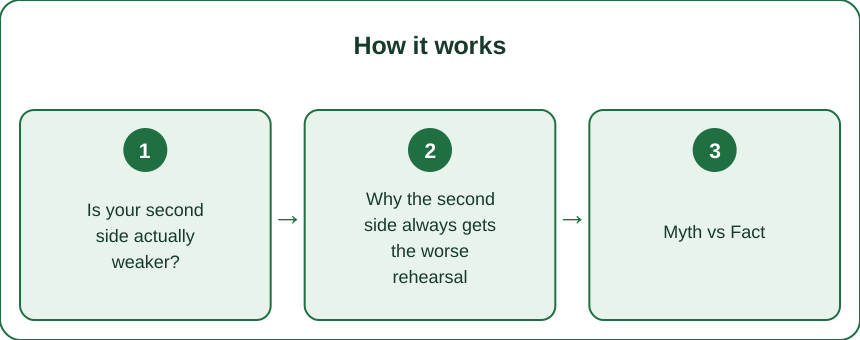
Is your second side actually weaker?
Usually not by much. Measured strength differences between sides in people without injury tend to run around 10 percent or less, which is nowhere near enough to explain a tendu that looks fine one way and mysterious the other.
What differs far more is coordination — the speed and precision with which your nervous system sequences a movement it has practiced less. Ballet is a coordination sport dressed as a strength sport, and coordination is much more side-specific than muscle is.
There’s a simple test. Do the movement on your second side at half speed, alone, with no music, thinking about nothing else. If it looks noticeably better than it does in class, the problem isn’t tissue. Strength deficits don’t disappear when you slow down. Sequencing problems do.
That single test redirects most people away from months of pointless conditioning.
Why the second side always gets the worse rehearsal
Look at what actually happens in class. The teacher demonstrates, usually facing one direction. You mark it. You perform it on the first side while the demonstration is thirty seconds old.
Then you turn. The demonstration is now ninety seconds old and mirrored. You’re mildly out of breath. You’re mentally reviewing what went wrong on side one instead of preparing side two. And you have about four counts of transition to reconstruct a mirrored version of something you’ve done exactly once.
Your second side is not getting a rehearsal. It’s getting a translation, under time pressure, while tired. Do that twice a week for two years and of course the two sides diverge.
This is also why the gap often looks worst in fast petit allegro and best in slow adage. Adage gives your second side enough time to solve the problem. Allegro doesn’t.
Myth vs Fact: The Weak Side
Myth: You need to strengthen your weak side with extra conditioning. Fact: For most adult dancers the gap is coordination, and conditioning trains the wrong system. Test at half speed before you add a single exercise.
Myth: Doing everything twice as much on the second side closes the gap. Fact: Volume of a poorly executed movement builds a poorly executed pattern. Quality of the repetition matters more than the count — three deliberate ones beat twelve rushed ones.
Myth: Your standing leg is the problem. Fact: More often it’s the supporting hip’s ability to stabilize while the eyes and head move. Turns and balances expose this, which is why side two feels fine at barre and falls apart in center.
Myth: It evens out eventually if you just keep taking class. Fact: Class as structured actively maintains the gap, because the order never changes. Something has to change for the gap to close.
What actually closes the gap?
Four changes, in order of how much they return for the effort:
1. Reverse the order at home. Any exercise you practice outside class — tendus at the kitchen counter, relevés, pirouette preparations — always start on your second side. It gets the fresh attention for once.
2. Slow the second side down in class when you can. In a marking pass or a repeat, take the second side at 70 percent speed and full accuracy rather than full speed and approximation. You’re building the pattern, not performing it.
3. Watch the demonstration mirrored. When the teacher demonstrates, deliberately visualize it on your second side rather than your first. It costs nothing and it front-loads the translation you’d otherwise do under pressure.
4. Give the second side its own separate practice. Ten minutes, twice a week, second side only, no music, half speed. This is where the actual change happens — the same reason a musician practices the hard bar alone rather than replaying the whole piece.
Expect a six to eight week timeline before it shows up in class, and expect it to show up first in slow work.
When is it not just coordination?
There are cases where the gap is structural, and it’s worth knowing the signs so you don’t slow-practice your way through a real problem.
Get it looked at if you have pain, not just difficulty — particularly a deep pinch at the front of the hip in développé or a sharp catch in passé. Difficulty that’s symmetrical in pain but asymmetrical in range is a different conversation than one side simply being clumsier.
Also worth a professional look: a side difference that appeared suddenly rather than always being there, any noticeable difference in how far the two hips rotate when you’re lying down and relaxed, and clicking that comes with pain rather than just noise.
Rotation range genuinely does differ between sides in many people for bony reasons, and no amount of practice changes bone. A physical therapist who works with dancers can tell you in one session which category you’re in. This is general information, not medical advice — if something hurts, get it assessed rather than training through it.
FAQ: Second Side Questions, Answered
Should I ask the teacher to start on the other side sometimes?
Yes, and most teachers will say yes if you ask after class rather than during. Many alternate already once they know a class wants it. It’s the single cheapest structural fix available.
Does my weaker side mean my turns will never be even?
No. Turns are the most coordination-dependent thing in the vocabulary, which means they’re also the most trainable. They’re usually the last to even out, not the impossible case — plan on months rather than weeks.
Is it worth filming both sides?
It’s the fastest diagnostic you have. Film the same eight counts on both sides and watch them back at half speed. Most dancers discover the difference is one specific moment — a hip that drops, a shoulder that leads — rather than the whole phrase being worse.
TL;DR:
- The gap is usually coordination, not strength. Test it at half speed — if it improves, it isn’t a strength problem.
- Class structure actively maintains the gap: your second side always gets a rushed, tired, mirrored translation.
- Practice at home second side first, always.
- Take the second side slower and more accurately in class rather than faster and rougher.
- Give the second side its own ten-minute, half-speed practice twice a week, and expect six to eight weeks before it shows.
- Pain, sudden onset, or a real rotation difference is a different problem — get it assessed.
You don’t have a bad side. You have a side that has never been given a fair rehearsal.
Keep Reading
This article is for general informational and styling purposes only. Fit, sizing, and product availability may vary.