How to Measure Adult Ballet Progress When Nothing Feels Different
Quick Answer: Adult ballet progress shows up first in recovery speed, not in the shape of a position. Track four things instead of the mirror: how quickly you regain balance after a wobble, how many counts you can hold correct alignment before it degrades, how fast you pick up new combinations, and how sore you are two days after class. All four move well before extension or turnout visibly changes.
Six months in, the arabesque looks about the same height as it did in March. That is the measurement everyone reaches for, and it is close to the slowest-moving one there is. Meanwhile four other things have almost certainly changed, and nobody told you to look at them.

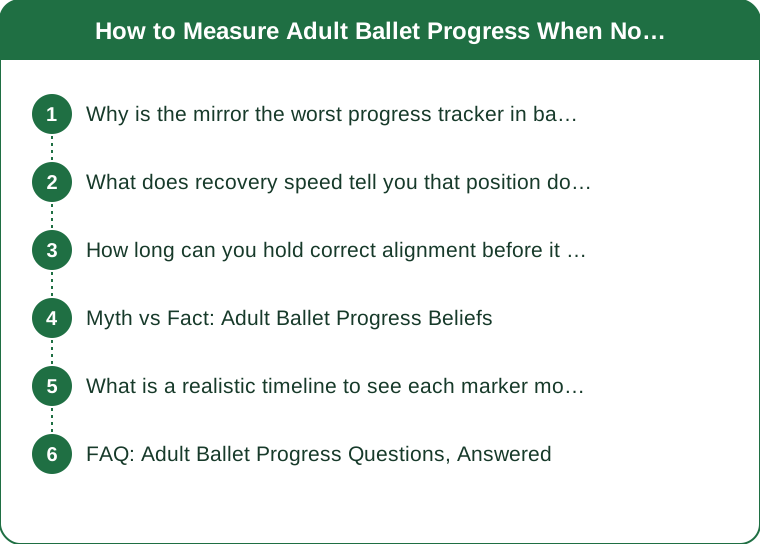
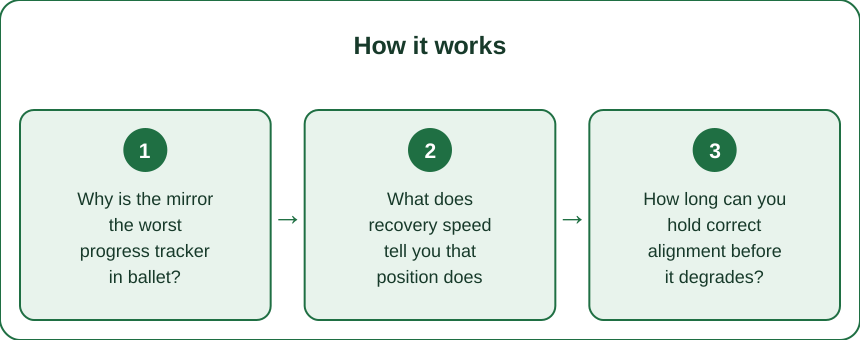
Why is the mirror the worst progress tracker in ballet?
The mirror shows position, and position is the last thing to change. Range of motion in the hip develops over years. Neuromuscular control - the part that determines whether a position is usable - develops in weeks and is nearly invisible in a still image.
There is also a comparison problem. You see your position next to everyone else’s in the same frame, which means the mirror mostly delivers information about other people’s training history.
The practical move is not to abandon the mirror but to demote it. Use it for specific corrections during exercises and ignore it entirely for the question of whether you are getting better.
What does recovery speed tell you that position does not?
How fast you recover from a wobble is the cleanest single marker of control. Early on a wobble ends the balance. Later the same wobble becomes a small correction and the balance continues.
This is worth tracking deliberately because it feels like nothing at the time. Nobody walks out of class thinking about how efficiently they recovered - they think about the balance they lost.
A simple version: at the end of barre, hold a passe releve and count how many corrections you make before it falls. Fewer corrections over the same duration is real, measurable improvement.
How long can you hold correct alignment before it degrades?
Duration of correct form is a better metric than achieving the form once. Most adult dancers can produce a correct position briefly. The question is whether it survives eight counts, then sixteen, then a full combination.
Pick one alignment cue your teacher gives you often - ribs closed, weight forward over the ball of the foot, shoulders down in port de bras - and count how far into the exercise it holds before it slips.
That number climbing over a month is more meaningful than a centimeter of extension, and it is the thing that eventually makes the extension possible.

Myth vs Fact: Adult Ballet Progress Beliefs
Myth: adults cannot make real progress in ballet after a certain age. Fact: the ceiling on professional-level range is genuinely different for adult starters, but strength, coordination, and musicality improve on essentially the same timeline as they do for anyone. Those three make up most of what class actually demands.
Myth: if you are not sore, class was too easy. Fact: decreasing soreness at the same class intensity is one of the clearest signs of adaptation. Chasing soreness in ballet mostly produces overuse in the hip flexors and calves.
Myth: flexibility is the main limiter for adults. Fact: strength at end range is the more common limiter. Many adults have passive range they cannot access actively, which looks identical to being inflexible and is trained completely differently.
Myth: taking more classes per week is the fastest route. Fact: three classes with two recovery days generally beats five back-to-back for adults training around a job, because connective tissue adapts far slower than the enthusiasm does.
What is a realistic timeline to see each marker move?
Pick-up speed for new combinations tends to move first, often within four to six weeks. You notice you are watching the demonstration once instead of three times, and the panic during petit allegro is quieter.
Recovery speed and alignment duration follow, usually somewhere in the two to four month range with consistent attendance. Both are subtle enough that you will miss them without deliberately checking.
Visible changes in extension, turnout, and jump height generally sit at six months to several years, which is exactly why using them as your primary measure is so discouraging. Track the fast markers, and let the slow ones arrive when they arrive.
FAQ: Adult Ballet Progress Questions, Answered
Should I film myself to track progress?
Yes, but at long intervals - once every eight to twelve weeks. Filming weekly tends to amplify the same discouraging comparison the mirror creates, since nothing visible changes in seven days.
Is it normal to feel worse before feeling better?
Very. When a teacher corrects an alignment habit, the corrected version feels wrong and unstable for several weeks because you are working muscles that were not previously doing the job. That awkward stretch is usually a sign the correction landed.
How do I know if I am plateauing or just impatient?
Check the fast markers. If pick-up speed and alignment duration are still moving, you are progressing and only the visible markers are lagging. If all four have been flat for two months, it is worth asking your teacher about changing the challenge.
TL;DR:
- Recovery speed after a wobble is the clearest early marker of control.
- Track how long correct alignment survives, not whether you can hit it once.
- Pick-up speed for new combinations improves first, often within six weeks.
- Extension and turnout are the slowest markers - stop using them as your gauge.
Adult ballet rewards patience, but patience is much easier when you can see something moving. Pick two markers from this list, note where you are this week, and check again at the end of September. The gap will be bigger than the mirror suggests.
Keep Reading
This article is for general informational and styling purposes only. Fit, sizing, and product availability may vary.