Why Comparing Yourself to the Kids' Ballet Class Down the Hall Is Sabotaging Your Progress
Quick Answer: Comparing adult beginner progress to child dancers ignores that children’s bodies develop flexibility and turnout differently and with years more cumulative training time — adult progress should be measured against your own starting point, not against dancers with a fundamentally different developmental timeline.
You watch the kids’ class doing full splits and effortless turnout on your way to your own beginner session, and something in your brain quietly files that as the standard you should be hitting. It isn’t, and holding yourself to it is actively working against you.
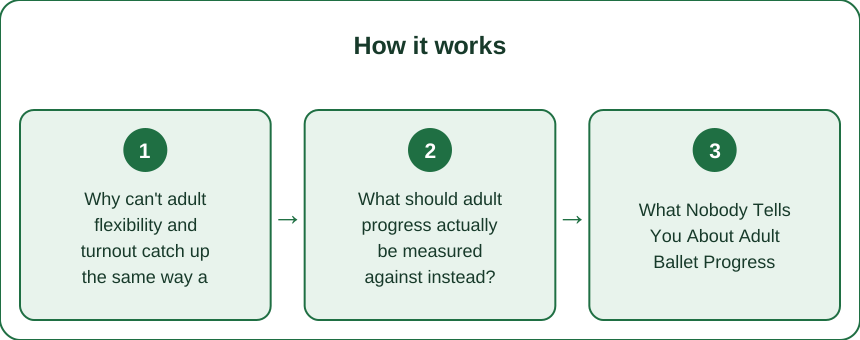
Why can’t adult flexibility and turnout catch up the same way a child’s can?
Children’s hip joint structure and connective tissue are still developing, which allows for a degree of natural turnout and flexibility adaptation that isn’t available once bone structure and connective tissue have fully matured in adulthood.
This isn’t about effort or discipline — it’s a genuine developmental biology difference, meaning an adult beginner working hard for a year is not failing by not matching a child who’s had years of development-stage training.
What should adult progress actually be measured against instead?
Your own baseline from when you started — improved balance, cleaner port de bras, more consistent turnout within your own joint limits, better musicality — these are the real markers of progress in an adult body, regardless of how they compare visually to a child dancer’s range.
Many adult ballet teachers specifically encourage tracking progress through video comparison against your own earlier sessions, precisely because it removes the false comparison to bodies on a different developmental track.
What Nobody Tells You About Adult Ballet Progress
Adult beginners often assume their teacher is silently comparing them to younger, more flexible students, but most experienced adult-focused ballet teachers evaluate students entirely against their own individual starting point and body, not against an absolute standard.
What surprises many adult students is how much technical and artistic progress is genuinely possible without ever reaching a child dancer’s flexibility — musicality, control, and precision are equally valid markers of skill that don’t require extreme range of motion.
Is there real value adult dancers have that young dancers don’t?
Yes — adult dancers typically bring far more body awareness, discipline, and intentionality to each movement, since they’re consciously choosing and understanding technique rather than absorbing it through years of repetition from a young age.
Many adult ballet teachers note that adult students often show much stronger musicality and expressive quality specifically because they bring life experience and deliberate focus that young dancers develop later, if at all.
FAQ: Adult Ballet Progress Questions, Answered
Is it too late to improve flexibility significantly as an adult beginner?
Meaningful flexibility improvement is absolutely still possible with consistent stretching and training — it just won’t match a child’s developmental-stage flexibility, and that’s a different (not lesser) outcome.
How long does it realistically take an adult beginner to feel comfortable in class?
Most adult students report feeling genuinely comfortable with basic vocabulary and barre work within 6-12 months of consistent practice, though this varies by prior movement background.
Should I switch to a different adult-only studio if I feel judged?
If comparison anxiety persists despite a supportive class environment, an adult-specific studio (rather than open-level classes with mixed ages) often removes that comparison pressure entirely.
TL;DR:
- Children’s developing joints allow flexibility adaptations not available in fully matured adult bodies
- Adult progress should be measured against your own starting point, not a child’s developmental-stage range
- Most adult-focused teachers already evaluate students individually, not against an absolute standard
- Adult dancers often bring stronger body awareness and musicality that compensates in different, equally valid ways
You’re not behind the kids’ class — you’re on a completely different track, and it’s worth measuring yourself only against that one.
Keep Reading
This article is for general informational and styling purposes only. Fit, sizing, and product availability may vary.