How Long It Actually Takes to See Progress in Adult Ballet
Quick Answer: Most adult beginners notice real balance and coordination improvement around 8-12 weeks of consistent (1-2x weekly) class, with visible turnout and line changes taking 6 months or more. Comparing week-4 progress to a lifelong dancer’s baseline is the fastest way to feel discouraged for no reason.
You’ve been to six classes. You still wobble in relevé, your turnout doesn’t look like the dancer next to you, and part of you is wondering if adult ballet is even realistic. It is — the timeline is just longer and less linear than most people expect walking in.
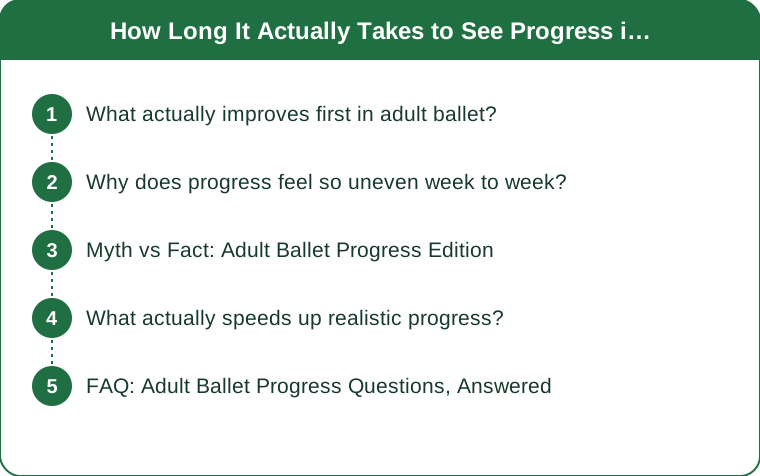
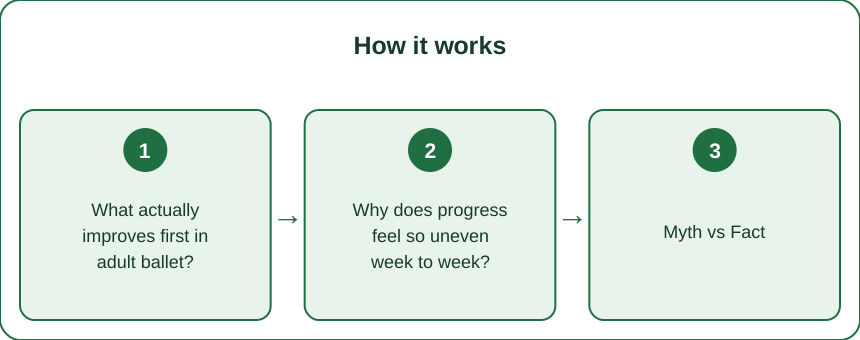
What actually improves first in adult ballet?
Balance and spatial awareness move fastest, usually noticeable within 6-10 classes. Your brain is learning a new coordination pattern, and that kind of neural adaptation happens quicker than physical range-of-motion change.
Turnout and flexibility lag behind — those depend on hip mobility work that compounds slowly, often 3-6 months before a visible shift, regardless of effort level in early weeks.
Why does progress feel so uneven week to week?
Skill acquisition in ballet isn’t a straight line — it’s closer to a staircase with long flat stretches. You might plateau for 3 weeks on a step, then suddenly feel a shift in one class with no obvious trigger.
That flat stretch is not stalling. It’s usually consolidation — your body integrating the last few weeks of input before the next visible jump.
Myth vs Fact: Adult Ballet Progress Edition
Myth: If you didn’t start as a kid, your turnout will never improve. Fact: Hip mobility responds to consistent stretching at any age — slower than a child’s, but real improvement over 6+ months is well documented.
Myth: Feeling wobbly after 2 months means you’re not cut out for it. Fact: Balance in adult beginners typically stabilizes around class 15-20, not class 5 or 6.
Myth: You should be able to keep up with combinations by month 3. Fact: Combination memory is its own separate skill from technique — many dancers nail the steps individually long before stringing them together smoothly.
What actually speeds up realistic progress?
Frequency beats intensity: 2 classes a week consistently outperforms 1 intense class plus long gaps, because ballet technique relies on frequent small corrections, not occasional big efforts.
Outside class, 10 minutes of hip and ankle mobility, 3x a week, meaningfully speeds up the turnout and balance timeline without adding another full class to your schedule.
FAQ: Adult Ballet Progress Questions, Answered
Is it too late to start ballet as an adult?
No — most studios’ adult beginner tracks are specifically designed around this exact starting point, and consistent students show clear technical growth over a year.
Why do I feel worse some weeks than others?
Fatigue, sleep, and even hydration affect balance noticeably in ballet — a rough class often reflects your day, not a skill regression.
How many classes before pointe or advanced work is realistic?
Most programs require a minimum of 1-2 years of consistent foundational training before pointe readiness is even assessed — there’s no shortcut on ankle and core strength.
TL;DR:
- Balance and coordination shift first, often within 6-10 classes
- Turnout and flexibility take 3-6+ months of consistent hip mobility work
- Plateaus are usually consolidation, not stalling — expect a staircase, not a line
- 2 shorter classes a week beats 1 intense class with long gaps
Give your current plateau 3 more weeks before judging it — that’s often exactly when the next jump shows up.
Keep Reading
This article is for general informational and styling purposes only. Fit, sizing, and product availability may vary.