Why Adult Ballet Feels Harder in Month Two Than It Did in Week One
Quick Answer: Month two feels harder because your awareness improves faster than your technique does - you start noticing every error you were happily blind to in week one. Combined with corrections moving from broad to precise and the novelty effect wearing off, the result feels like getting worse while you’re actually improving normally.
Week one you floated out of class feeling like a dancer. Week seven you leave frustrated and convinced you’ve regressed. Nothing has gone wrong. This is the most predictable phase of adult ballet, and knowing why makes it far easier to sit through.

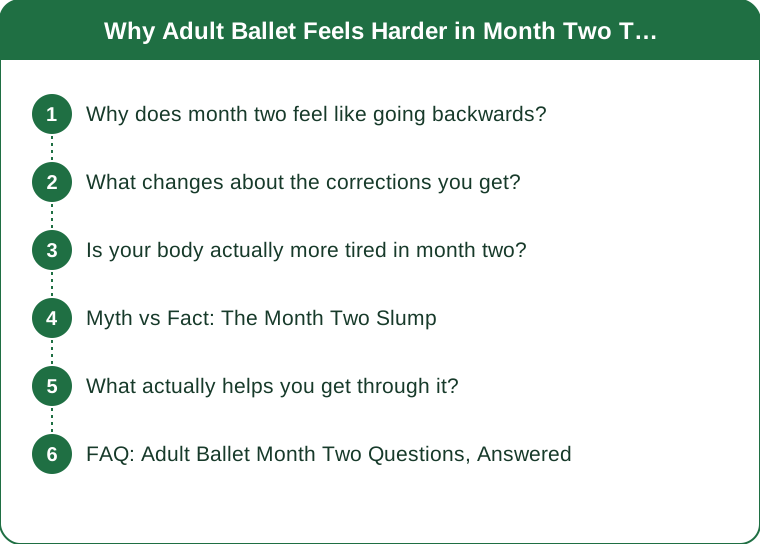
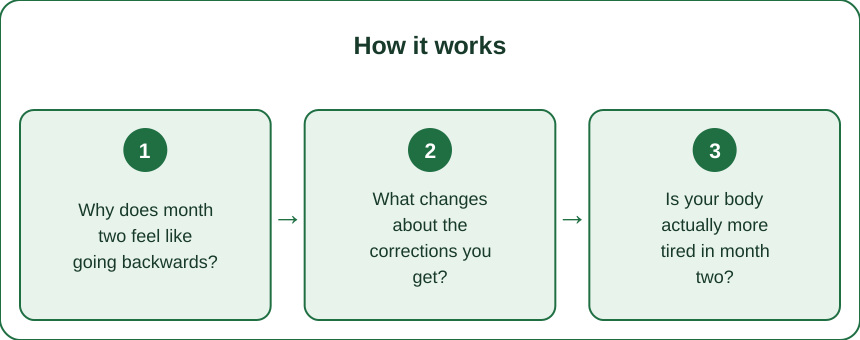
Why does month two feel like going backwards?
In week one, you couldn’t see your own errors. Your turnout was uneven, your shoulders crept up, your supporting side collapsed - and you had no idea, so class felt great.
By week seven, you’ve built enough of a mental model of correct ballet positioning to perceive the gap between what you’re doing and what it should look like. The gap didn’t grow. Your ability to see it did.
This is a well-known pattern in any skill acquisition, sometimes described as moving from unconscious incompetence to conscious incompetence. It feels awful and it’s a sign of genuine progress - you cannot fix what you can’t perceive, so this uncomfortable stage is a prerequisite for improvement rather than a detour from it.
The practical consequence: the frustration is information about your growing eye, not about your dancing.
What changes about the corrections you get?
Early corrections are broad and easy to act on: stand taller, point your feet, don’t grip the barre.
Around month two, corrections shift to precise ones - rotate from the hip rather than the knee, resist on the way down, keep the weight forward over the ball of the foot. These are harder to execute, harder to feel, and often correct something you thought you’d already fixed.
This shift is a compliment, though it rarely lands as one. Teachers give detailed corrections to students who can now handle them. Getting told to stand up straighter for three months would mean nothing had developed.
The practical challenge is that precise corrections often make things temporarily worse. Genuine hip rotation feels weaker and less stable than the fake turnout you were doing from the knee, so your tendus look shakier for a few weeks before they look better. That dip is the correction working.
Is your body actually more tired in month two?
Often, yes - and it’s frequently overlooked as an explanation.
Week one adrenaline and novelty mask fatigue. By month two, that’s gone, and you’re also asking more of small stabilising muscles that had never been recruited before: deep hip rotators, intrinsic foot muscles, the postural chain along the spine.
These muscles fatigue quickly and recover slowly compared to the large muscle groups most people have trained. If you’ve added a second class per week around this point - which many people do at exactly this stage - you may be genuinely under-recovered rather than technically stuck.
Worth checking: are you sleeping the same amount as in week one? Are you taking a full rest day between classes? Adult beginners often discover that the fix for a month-two plateau is one more rest day, not one more class.
Myth vs Fact: The Month Two Slump
Myth: If you were going to be good at ballet, month two would still feel easy. Fact: Month two feels hard for essentially everyone, including people who go on to dance for decades. Difficulty at this stage carries no information about your ceiling.
Myth: Feeling worse means your technique has degraded. Fact: Perception improves faster than execution. Video from week one usually looks noticeably worse than you remember - which is the clearest available proof that you’ve improved, not regressed.
Myth: You should push through by adding more classes. Fact: Adding volume during an under-recovery period is one of the more common ways adult beginners end up with a hip or foot injury. More rest is the more likely fix.
Myth: Everyone else in the class has this figured out. Fact: The students who look settled have usually just passed through this same stage. Ask one - the answer is almost always ‘oh, month two was terrible for me too.‘
What actually helps you get through it?
Film yourself once a month, from the same angle. Memory of your own dancing is unreliable and biased toward whatever you last got corrected on. A monthly clip is the only honest record, and comparing month one to month two usually ends the regression argument immediately.
Pick one correction per week. When corrections turn precise, trying to hold six at once means holding none. Choose the one your teacher repeats most often and work only on that for a full week.
Separate ‘hard’ from ‘wrong.’ A step that feels awkward because you’re rotating properly for the first time is not a step you’re doing badly. Learning to distinguish these is one of the main skills of month two.
Extend your horizon. Adult ballet progress is realistically measured in six-month increments, not weekly ones. A plateau that feels enormous across three weeks disappears entirely on a six-month view.
Stay for the whole class on bad days. The instinct is to leave early when it isn’t going well - but showing up for a mediocre class is what builds the base that makes month four good.
FAQ: Adult Ballet Month Two Questions, Answered
How long does the month two slump last?
Commonly 3-6 weeks. Most adult beginners report a clear shift somewhere between month three and month four, when the precise corrections start to land physically.
Should I switch to an easier class?
Usually no. If you’re following the class and getting corrections, you’re in the right level. Dropping down often removes the challenge without removing the frustration.
Is it normal for one side to feel dramatically worse?
Yes. Nearly everyone has a stronger and weaker side, and month two is typically when you first become aware of it. It evens out slowly with consistent work on both.
What if I genuinely dread going now?
Dread that lasts more than a few weeks is worth examining - it might be the class culture, the schedule, or a teacher fit rather than the stage of learning. Trying a different studio is a reasonable experiment before quitting entirely.
TL;DR:
- Month two feels harder because your eye improves faster than your technique
- Corrections turn precise, which temporarily makes movements look and feel worse
- Under-recovery is a common and overlooked contributor at this exact stage
- Film yourself monthly - it’s the only honest record of progress
- Work one correction per week rather than six at once
The frustration is a sign you can now see what you’re doing. That’s the whole point of month two.
Keep Reading
This article is for general informational and styling purposes only. Fit, sizing, and product availability may vary.