Why You Blank on Combinations in Adult Ballet (and How to Make Them Stick)
Quick Answer: Blanking mid-combination is a working-memory overflow, not a talent problem. Adults try to hold the sequence as a word list - glissade, jete, assemble - while also executing technique, and the list gets evicted the moment the body needs attention. The fix is changing the format: mark the combination physically during the demonstration, chunk it into two or three named phrases, and anchor the first step of each phrase. Memory for movement sticks when it is stored as movement.
The teacher demonstrates, you nod along - it all makes sense. Four counts in, your feet are improvising and your brain is a corridor of open doors. Meanwhile the teenager next to you absorbed it in one viewing.

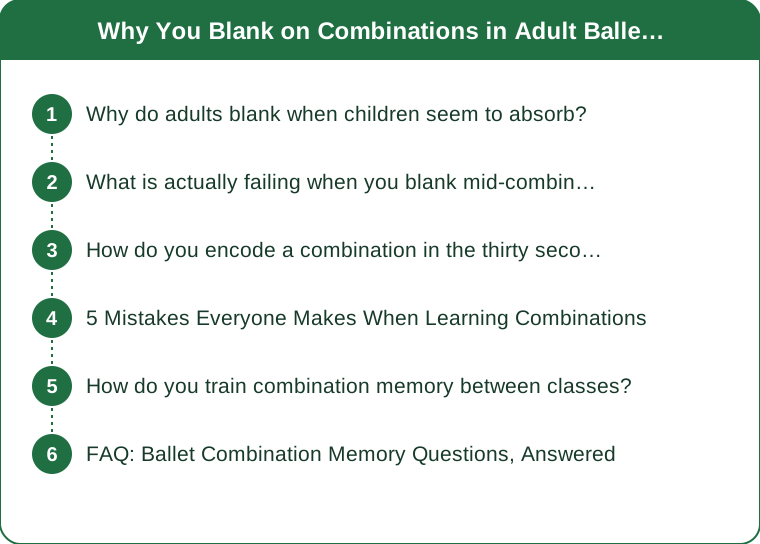
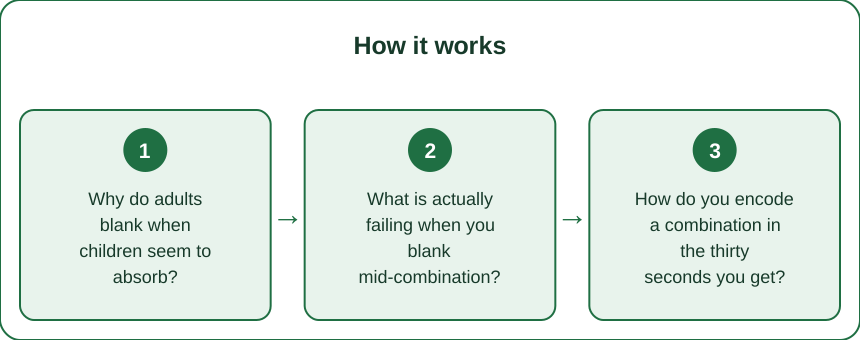
Why do adults blank when children seem to absorb?
Three honest reasons, none of which is a worse brain.
Adults translate; children copy. A child watches the demonstration and mirrors shapes directly. An adult beginner routes everything through language - hearing glissade, remembering what a glissade is, recalling which foot leads - and that translation layer is slow and expensive. Dancers with years of vocabulary skip it, which is most of what looks like magical memory.
Working memory is the bottleneck, and it is small. The classic capacity is roughly four chunks for anyone, at any age. An eight-step combination held as eight separate items is already double the budget. Experienced dancers hold the same combination as two or three familiar phrases - a balancé pattern, a pirouette preparation - so it fits.
Self-monitoring eats the remainder. Adults run a constant commentary - am I on the right foot, do I look ridiculous, she said shoulders down - and that commentary occupies the exact cognitive workspace the sequence needed. Children mostly do not have this channel open yet.
So the blank is not memory failing. It is a storage format problem plus a capacity problem plus an attention tax, and every one of those has a practical workaround. What it is not is evidence you started too late.
What is actually failing when you blank mid-combination?
It helps to know which of two distinct failures you are having, because the fixes differ.
Encoding failure: the sequence never got in. You watched the demonstration but did not convert it into anything durable - you were watching the teacher’s quality, or fixing your leotard, or still processing step two while she showed step six. The tell: you cannot recite the combination even standing still afterward. No amount of trying harder mid-dance retrieves what was never stored.
Retrieval-under-load failure: it is in there, but the body pushed it out. You can say the sequence in the corner, yet it dissolves once you are moving. This is working memory being asked to hold the list and run technique and track music simultaneously. The tell: the blank arrives exactly when something gets physically demanding - the turn, the direction change - because that is when the body demands the workspace.
Most adults have the second problem and treat it like the first, drilling the verbal list harder. But a verbal list is the most fragile possible format under physical load. The durable format is motor and musical - the combination stored as felt phrases attached to the melody - which is why the fixes that work are all about converting words into movement as early as possible, not gripping the words tighter.
How do you encode a combination in the thirty seconds you get?
The demonstration window is short, so spend it deliberately.
Mark while she demonstrates - always. Small feet, hand gestures for the legs, weight shifting in place. Marking converts the sequence into motor memory on the first pass instead of the fifth. Standing politely still while watching is the single most costly habit adult beginners have, and it feels like good manners.
Chunk immediately into two or three phrases. Find the natural seams - usually a direction change or the musical phrase - and name each chunk crudely: the travel bit, the turn bit, the finish. Three labeled chunks fit in working memory; nine steps do not.
Anchor the first step of each chunk hard. Blanks happen at seams. If you know each phrase’s launch step cold - which foot, which direction - the rest of the phrase tends to unroll on its own, because motor sequences chain forward once started.
Attach it to the music, not to counting. Hum the melody mentally and hang the movement on it. Music is a retrieval structure your brain will maintain for free, and it never loses count the way you do.
Use the queue time. While the first group dances, mark it again, full attention. That second physical pass roughly doubles retention and costs nothing but the willingness to look like someone practicing - which, in a ballet studio, is everyone worth imitating.

5 Mistakes Everyone Makes When Learning Combinations
Mistake 1: Watching the demonstration like an audience member. Appreciating the teacher’s dancing is lovely and encodes nothing. Watch her feet and weight, and move with her. You are copying a machine’s settings, not enjoying a performance.
Mistake 2: Memorizing the whole thing as one string. One long string has one entry point, so an early error kills everything after it. Chunked combinations fail gracefully - lose phrase two and you can still catch phrase three at its anchored first step.
Mistake 3: Going full-out on the first attempt. The first pass through is a memory rehearsal wearing a dance costume. Dance it at 70 percent effort with 100 percent attention on sequence, then add performance quality on later passes once the order is cheap to retrieve.
Mistake 4: Rebooting from the top after every error. In the corner waiting, people restart their mental rehearsal from step one each time they stumble, so the ending never gets rehearsed at all - which is why endings are where everyone blanks. Practice the last chunk first sometimes. It feels wrong and works.
Mistake 5: Treating the person next to you as the backup drive. Following the front row feels safe and prevents encoding entirely - you are reading, not remembering. One class spent deliberately dancing on the far side, where you cannot see anyone, tells you exactly what you actually know. The fourth mistake costs you endings; this one costs you everything, invisibly, for years.
How do you train combination memory between classes?
Ten minutes a week, no studio required.
Reconstruct the day’s combination within 24 hours. In the kitchen, marking with hands, to the same music if you can find it. Retrieving a nearly-lost sequence is precisely the muscle you are trying to build - the struggle to recall is the training, so do not look anything up until you have genuinely tried.
Build your phrase dictionary. Most teachers assemble combinations from a reusable kit: balancé pairs, pas de bourrée into fourth, glissade-assemblé. Each pattern you can execute without thinking becomes one chunk instead of four steps. Learning vocabulary is learning memory - this is the entire secret of the dancers who get it in one viewing.
Mark to music while doing something else. Waiting for the kettle, mark yesterday’s petit allegro. Low-stakes retrieval reps compound absurdly well for the cost.
Film the end of class when permitted. Not to study your lines - to re-mark along with your own recording twice during the week. Three spaced physical passes beat ten mental read-throughs.
Expect the curve to bend around month three or four. Regular adult students reliably report combinations starting to stick in one or two viewings - not because memory improved, but because the vocabulary finally chunked. The teenagers were never absorbing. They were recognizing. Soon you are too.
FAQ: Ballet Combination Memory Questions, Answered
Is it rude to mark while the teacher demonstrates?
Almost universally no - teachers read marking as engagement, and professional dancers do it reflexively. Keep it small and out of anyone’s dance space. If a teacher prefers stillness during demonstration, she will say so, and marking in the queue remains fair game.
Should I ask the teacher to repeat the combination?
Once, yes - and ask specifically: could I see the second phrase again? A targeted question gets a better answer than a general help, and it signals exactly where your encoding dropped. Every adult in the room silently benefits from your asking.
Why do I remember barre fine but blank in center?
Barre combinations are shorter, repeat structurally side to side, and the barre itself removes the balance load that competes for working memory. Center adds space, direction changes, and no support - pure retrieval-under-load. It is not a different memory; it is a heavier backpack.
Does age actually make this harder?
Working memory capacity declines modestly with age, but vocabulary and chunking swamp that effect completely. A 55-year-old with two years of consistent classes out-remembers a 25-year-old beginner every single time. The variable that matters is accumulated patterns, and it is entirely purchasable with attendance.
TL;DR:
- Blanking is working-memory overflow: a verbal step-list gets evicted the moment technique demands attention
- Mark during every demonstration - physical encoding on the first pass is the highest-value habit in class
- Chunk into two or three named phrases and anchor each phrase’s first step; blanks live at the seams
- Hang the sequence on the melody, not on counting - music is free retrieval structure
- Reconstruct combinations within 24 hours and build your pas de bourrée vocabulary; by month three, combinations chunk themselves
The dancers who catch a combination in one viewing are not remembering more than you - they are remembering less, in bigger pieces. Vocabulary turns nine steps into three phrases, and three phrases fit. Attendance builds the dictionary, and the dictionary is the memory.
Keep Reading
This article is for general informational and styling purposes only. Fit, sizing, and product availability may vary.