Why Your Standing Leg Wobbles in Adage and What Fixes It
Quick Answer: Wobbling in adage almost always comes from the standing hip rather than the foot. When the gluteus medius on the supporting side cannot hold the pelvis level, the body compensates with rapid ankle corrections, which is what you feel as wobble. Slow single-leg loading work, standing-side hip strength, and practising adage at half height fix it faster than any amount of balance practice.
You can balance in a passé all day. Then the adage starts, the working leg extends, and the standing side begins its familiar shiver.
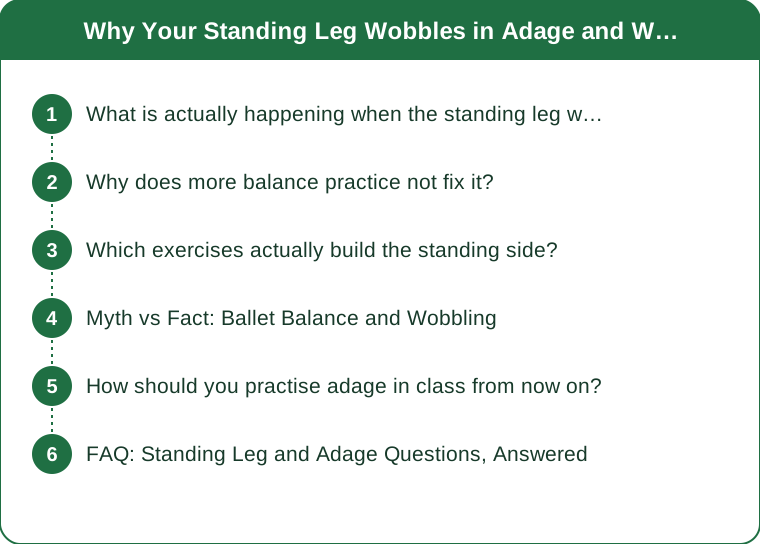
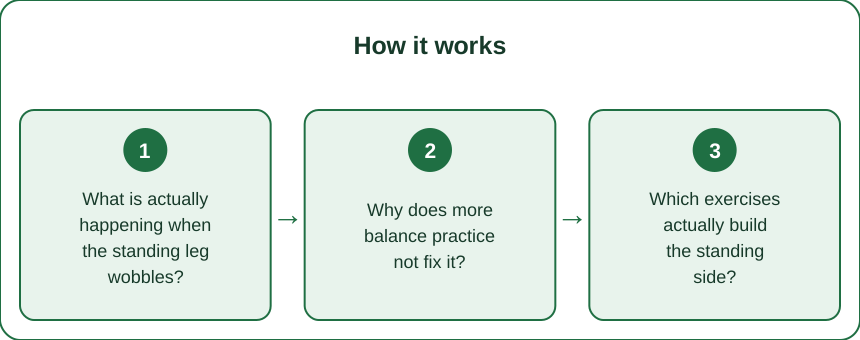
What is actually happening when the standing leg wobbles?
The visible tremor is at the ankle, which is why everyone tries to fix the foot. The cause is usually two joints higher.
Standing on one leg means your gluteus medius and deep hip stabilisers on that side are holding the pelvis level against gravity. That is a static holding job and it is harder than it sounds. Now extend the other leg away from the body in a développé and you have added a long lever pulling the pelvis off level.
If the standing hip cannot hold that, the pelvis drops or rotates a fraction. Your nervous system notices instantly and corrects, but the fastest available correction is at the ankle - so you get a rapid series of small ankle adjustments. That is the wobble. It is a symptom of a hip that ran out of capacity, appearing at the joint furthest from the problem.
The pattern gives it away:
- Static passé is fine, moving adage is not - the hold is fine, the lever is not
- The wobble arrives as the leg extends, not at the start
- It is often worse on one side by a clear margin
- It gets worse late in class, which is a fatigue signature rather than a technique one
All four point at strength and control on the standing side.
Why does more balance practice not fix it?
Because standing still on one leg trains a different thing than adage requires.
A static balance is a stability task with no changing load. Adage is stability under a moving external lever - your working leg is a substantial mass moving further from the midline, changing the demand continuously. Being good at the first does not transfer to the second, in the same way that holding a plank does not make you good at carrying an awkward box.
The second issue is that most balance practice happens at low intensity for a long duration, which trains endurance in a position you already own. What is missing is capacity at the hardest moment - the point where the leg reaches its highest extension and the lever is longest.
There is also a common technique loop that hides the strength gap. When the hip cannot hold, dancers unconsciously:
- Grip the standing hip and quad to create rigidity instead of control, which feels stable for two seconds then shakes harder
- Shift weight back into the heel, which reduces the foot’s ability to make fine adjustments
- Lift the working leg with the hip flexor and lower back, which tilts the pelvis and makes the standing side’s job harder still
Each of those makes the wobble worse while feeling like an attempt to fix it.
Which exercises actually build the standing side?
Slow, unglamorous, and specific. Two or three sessions a week, ten to fifteen minutes.
Standing hip holds against the wall. Stand on one leg, other knee bent to hip height, and press the lifted knee gently into a wall beside you. Hold 20 to 30 seconds, 3 rounds each side. This loads the standing gluteus medius directly with no balance demand, which is the point - you are building the missing capacity, not testing it.
Slow single-leg lowers from a step. Stand on one leg on a low step, lower the other heel towards the floor over 4 seconds, return. 8 to 10 reps, 3 sets each side. This trains pelvic control through a moving range, which is much closer to adage than a static hold.
Développé at half height, very slowly. Take the working leg to 45 degrees rather than as high as it goes, and take 8 counts to get there. Height is what breaks the pattern; removing height lets you practise the actual coordination. Add height only once the slow version is quiet.
Side-lying hip lifts, controlled. 12 to 15 reps, 2 to 3 sets, no momentum, no rolling backwards. Basic and effective for the muscle group that is usually the limiter.
Weight-bearing foot work. Rises with the heel travelling straight up over the second toe, 15 reps slow, to give the ankle a better platform to correct from - support work rather than the main fix.
Myth vs Fact: Ballet Balance and Wobbling
Myth: Wobbling means weak ankles. Fact: The ankle is doing the correcting, which is why you feel it there. In most adults the ankle is capable and the standing hip is the limiter. Ankle work helps at the margins; hip work changes the picture.
Myth: You should practise without the barre to build balance faster. Fact: Removing the barre before the strength exists just means you practise the compensations - gripping, weight shifting, and hip-flexor lifting - with more intensity. Use the barre with one or two fingers, not a grip, and leave it when the pattern is clean.
Myth: Stronger core means better balance in adage. Fact: Trunk strength helps, but adage load is largely frontal-plane hip work, and standard core exercises train the sagittal plane. Planks and crunches do not cover the gluteus medius demand.
Myth: It will resolve on its own with more classes. Fact: Sometimes, slowly. But class rarely contains enough targeted single-leg loading to build the missing capacity, which is why adults can attend for two years and keep the same wobble. Ten minutes twice a week outside class usually shifts it in six to eight.
Myth: A wobble is embarrassing and means you are behind. Fact: It is the most common adult-ballet complaint there is, and it appears in dancers with good flexibility and good technique. It is a capacity gap, not a talent signal.
How should you practise adage in class from now on?
Change what you are paying attention to, and lower the target.
Set the standing side before the working leg moves. Weight over the whole foot, standing hip level, ribs stacked over pelvis. Take a full breath to check it. Most wobbles are decided before the leg leaves the ground.
Take the working leg to a height you can control, not your maximum. In an eight-count développé, arriving at 45 degrees with a level pelvis is real progress. Arriving at 90 with a dropped hip and a shaking ankle is a rehearsal of the problem.
Watch the pelvis, not the foot. In the mirror, check whether the hip on the working side lifts as the leg extends. That lift is the compensation. If you cannot see it, film one adage on your phone - the answer is usually obvious in the first attempt.
Use the barre honestly. Fingertips only. If you need a grip, you are working above your current capacity and the extra height is buying nothing.
Expect one side to lag. A clear left-right difference is normal and usually reflects everyday habits rather than anything in ballet. Give the weaker side one extra set in the strength work and re-check in a month.
If a wobble comes with pain in the standing hip, groin, or knee, or with any giving-way sensation, get it assessed rather than trained through. This is general information, not medical advice.
FAQ: Standing Leg and Adage Questions, Answered
How long before the wobble improves?
With two or three targeted sessions a week, most adults notice a difference in four to six weeks and a clear change by eight to twelve. Strength changes are slower than technique cues but they hold.
Should I stop trying high extensions until it is fixed?
Not stop, but stop using maximum height as the daily target. Practise the pattern at controllable height and test the high version occasionally. Practising at a height you cannot control reinforces the compensation.
Does turnout affect the standing leg wobble?
Yes. Forcing turnout on the standing side rotates the pelvis and reduces stability. Working within the rotation your hip actually has usually makes the standing leg quieter immediately.
Is a wobble worse when I am tired a bad sign?
It is a normal fatigue signature and useful information - it tells you the limit is capacity rather than skill. If it appears in the first ten minutes of class, that is more likely a control or alignment issue worth asking your teacher to watch.
TL;DR:
- The wobble you feel at the ankle is usually a standing-hip capacity problem
- Static balance and adage are different tasks - one holds, the other resists a moving lever
- Build with wall hip holds, slow single-leg lowers, half-height développé, and side-lying lifts
- Gripping the hip, shifting into the heel, and hip-flexor lifting all make it worse
- Expect four to six weeks for a noticeable change and a clear left-right difference
Adults often treat the wobble as proof they started too late. It is far more mundane than that: one muscle group has not yet been asked to hold a long lever, and asking it to do so twice a week for a month and a half changes the answer.
Keep Reading
This article is for general informational and styling purposes only. Fit, sizing, and product availability may vary.