Why Your Turnout Isn't Improving - and What Adult Beginners Get Wrong About It
Quick Answer: Turnout comes from external rotation at the hip joint, and a meaningful portion of your available range is set by bone structure that will not change at any age. What can improve is how much of your existing range you actually access and control - usually through deep rotator strength rather than stretching. Adults commonly force turnout at the feet and knees, which looks wider and is both less stable and genuinely risky.
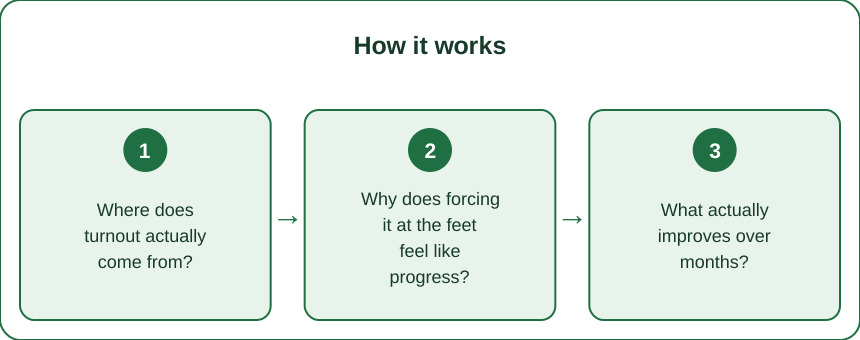
Where does turnout actually come from?
Five joints contribute, and they contribute very unequally.
The hip is the main event - roughly 60% of usable turnout in most people comes from external rotation at the hip joint. The rest is distributed through the knee, ankle, and foot, with the tibia contributing a small amount of natural rotation.
That distribution is why the standard cue matters so much: turnout is initiated from the top and finished at the floor, never the other way around.
What limits hip rotation is a combination of factors, and only some are trainable:
- Femoral neck angle and acetabular orientation - bone shape, fixed in adults
- Hip capsule and ligament length - changes very slowly, if at all
- Deep external rotator strength and control - highly trainable
- Habitual movement patterns and awareness - highly trainable
The honest version nobody enjoys hearing: two dancers can train identically and end up with visibly different maximum turnout because of the first item on that list.
Why does forcing it at the feet feel like progress?
Because it produces an immediately wider first position, and immediate visible change is very persuasive.
What’s actually happening when you force turnout from the floor: the foot rolls inward at the arch - pronation - the knee rotates relative to the hip, and the lower leg twists. The knee is a hinge with limited rotational tolerance, and it becomes the shock absorber for rotation the hip didn’t produce.
The signs you’re doing it, which are easy to check yourself:
- Your arches collapse inward in first position
- Your knees track inside your toes in a plié rather than over them
- Your weight sits on the inside edge of your feet
- Your position is noticeably wider standing still than it is in a plié
That last one is the clearest tell. If your turnout shrinks the moment you bend your knees, the standing version was borrowed from your feet, not produced by your hips.
This is a genuine injury pathway over time - knee and foot problems in dancers are commonly associated with rotation forced below the hip. Working within your real range is the conservative and the faster option.
What actually improves over months?
Control and strength, far more than passive range.
Deep external rotator strength is the highest-return work. The six deep rotators are small, easily under-trained, and are what hold rotation while you move rather than while you stand. Clamshells, seated band rotations, and slow controlled rotation work in a hip-neutral position all target them. Three sets of 12-15 with a slow tempo, three times a week, is a reasonable dose - these are endurance-biased muscles and heavy loading isn’t the point.
Standing control drills transfer better than floor work alone. Slow tendu in a comfortable first, focusing entirely on where the rotation is initiated, is dull and effective.
Working turnout, not maximum turnout. Almost every adult beginner stands in a wider first than they can actually control. Narrow it until you can hold rotation through a full plié without the arches collapsing, then work there. Your working turnout widens over months as control improves - and it widens from the hip, which is the only kind that holds up in movement.
Passive stretching does much less than people hope for external rotation, and aggressive stretching of the hip capsule carries its own risks. Prioritise strength.
What Nobody Tells You About Adult Turnout
Your two hips are almost certainly different. Asymmetry in external rotation range is extremely common, and adults notice it more than children because they compare more. Work each side to its own range rather than matching the wider one - matching the wider side means overreaching on the tighter one, every single class.
Turnout range can be worse in the evening after a day of sitting. Prolonged sitting shortens and stiffens hip structures temporarily. An evening class after a desk day may genuinely give you less than a weekend morning class does, and that’s not regression.
Warm-up affects it more than months of training do, in the short term. Ten minutes of proper hip warm-up can produce more immediate range than six weeks of stretching. This is why turnout feels dramatically better in the second half of class.
Adults started late, not wrong. Some turnout adaptation in professional dancers happens during childhood skeletal development. That window is closed for adult starters, and it changes your ceiling, not your ability to dance well or improve substantially.
The wider position is rarely the better-looking one. A controlled, held 60 degrees reads as far cleaner in movement than a forced 90 that collapses in every plié. Audiences and teachers see the collapse, not the standing width.
How should you actually work in class?
Practical adjustments that make the next class better.
Set first position by rotating from the hips and letting the feet land where they land. Stand parallel, rotate the thighs outward as far as you can control, and note where your feet end up. That’s your working first. Marking that width mentally stops you drifting wider as class goes on.
Use plié as your honesty check. If knees track over toes and arches stay lifted through a demi-plié, your position is real. If not, narrow it. Do this check at the start of every class - it takes fifteen seconds.
Tell your teacher you’re working on rotation source. Most teachers will happily watch one plié and tell you exactly where you’re borrowing from. This is a better use of a class than any amount of self-diagnosis in a mirror.
Add the rotator work outside class, not during it. Ten minutes, three times a week, at home. Class time is for dancing.
And check any persistent knee, hip, or foot pain with a professional rather than training through it. Pain during rotation work is a signal, not a phase. This is general information, not medical advice.
FAQ: Adult Ballet Turnout Questions, Answered
Can adults improve turnout at all?
Yes - meaningfully, through strength and control. What adults generally can’t change is the bone structure component, which sets an individual ceiling.
How long before I see a difference?
Control improvements are often noticeable within 6-8 weeks of consistent rotator work. Any change in comfortable working width tends to show over several months.
Are turnout boards or stretching devices useful?
Most force rotation passively below the hip, which is exactly the mechanism you’re trying to avoid. Skip them.
Should I compare myself to the dancer next to me?
No, and not out of politeness - their femoral anatomy is a different starting point. Compare your plié today to your plié two months ago.
TL;DR:
- Roughly 60% of turnout comes from hip external rotation; bone structure sets an individual ceiling
- Forcing it at the feet collapses arches, twists knees, and is a genuine injury pathway
- Strength and control of the deep rotators is what actually improves; passive stretching does little
- Use demi-plié as your honesty check - if turnout shrinks when you bend, it wasn’t real
- Work your controllable range, not your widest standing position
A controlled turnout you own beats a wide one you’re borrowing, in every single class and every single performance.
Keep Reading
This article is for general informational and styling purposes only. Fit, sizing, and product availability may vary.