Why Does Turnout Hurt Your Hips in Adult Ballet? What's Normal vs. What's Not
Quick Answer: Hip discomfort from turnout is usually a sign you’re forcing rotation from the knees and ankles instead of the hip joint — true turnout comes from external hip rotation, and most adult beginners have significantly less natural range than the visual standard suggests, which is completely normal.
You watch your teacher’s effortless-looking turnout and try to match it, and your hips start protesting. That gap between what you see and what your joints allow is the actual issue — and forcing it is where pain starts.
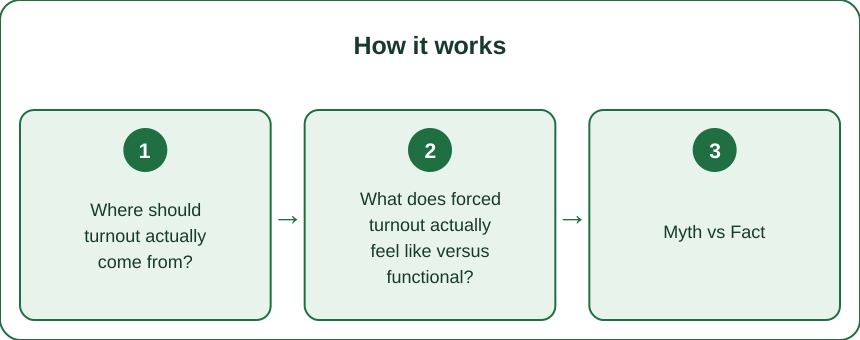
Where should turnout actually come from?
The hip joint, specifically the external rotators — not the knees, not the ankles, and definitely not by rolling onto the inner edge of your feet to fake extra degrees of rotation.
Many adult beginners have a natural turnout range of 30-45 degrees per leg from the hip alone — well short of the 90-degree ‘flat’ turnout that looks achievable on trained dancers who often started as children, when joint structure was still developing. Forcing beyond your actual hip range shifts the rotation demand onto your knees, which aren’t built for it.
What does forced turnout actually feel like versus functional?
Functional turnout: a stretch sensation in the outer hip/glute area, controllable, and it releases when you consciously relax.
Forced turnout: sharp or pinching sensation at the front of the hip or inside the knee, often paired with feet rolling inward (‘rolling in’ or pronating) to manufacture extra visual rotation the hip isn’t actually providing.
If you can feel your knee twisting relative to your foot’s direction, that’s the clearest sign the rotation is coming from the wrong joint.
Myth vs Fact: Adult Ballet Turnout
Myth: Turnout is mostly about stretching. Fact: Turnout range is largely determined by hip socket structure, which varies significantly between individuals and doesn’t change dramatically with stretching alone — strength and control matter as much as flexibility.
Myth: You should always dance at your maximum turnout. Fact: Trained dancers regularly work at less than their maximum in class to maintain proper alignment — using 100% of your range in every position is a fast path to compensation injuries.
Myth: Adult beginners can’t improve turnout meaningfully. Fact: Strength in the deep hip rotators can improve control and usable turnout even without changing bone structure — it’s just a slower, subtler process than a beginner might expect.
How do you train turnout safely as an adult beginner?
Work within your honest range, not your visual goal — a teacher watching your knee-to-foot alignment can tell you where that honest range actually is far better than a mirror can.
Strengthen the deep hip external rotators off the barre with exercises like clamshells and standing hip rotations — stronger rotators give you more usable turnout within your existing range, even if your maximum range doesn’t change much.
And check your feet: if your arches are collapsing inward during turnout positions, that’s your body compensating for a hip range it doesn’t have — pull back the degree of turnout until your foot can stay properly arched.
FAQ: Adult Ballet Turnout Questions, Answered
Can adults improve their turnout with practice?
Somewhat — strength and control within your existing range can improve meaningfully, though bone structure limits how much the maximum range itself changes.
Is it normal for hips to feel tight after ballet class?
Mild tightness or fatigue is normal; sharp pinching pain, especially at the front of the hip, is not and is worth mentioning to your instructor or a professional.
Should I tell my ballet teacher about hip discomfort?
Yes — a good adult ballet teacher will happily adjust your turnout expectations and check your alignment rather than push you toward pain. This is general information, not medical advice.
TL;DR:
- True turnout comes from hip external rotation, not knees, ankles, or rolled-in feet
- Sharp or pinching pain, especially at the knee, signals forced rather than functional turnout
- Most adult beginners have far less natural range than trained dancers — that’s normal, not a failure
- Strengthening deep hip rotators improves usable turnout even without changing your maximum range
Work within your honest range and let control build over time — forcing it is the injury shortcut, not the progress shortcut. This is general information, not medical advice.
Keep Reading
This article is for general informational and styling purposes only. Fit, sizing, and product availability may vary.