Coming Back to Adult Ballet After an Injury: What Your First Class Back Should Actually Look Like
Quick Answer: Your first class back after injury should be barre-only, at 60-70% of your pre-injury range of motion, with permission to skip any movement that causes sharp (not muscular) discomfort. Center work and jumps wait until barre feels fully normal for 2 consecutive classes.
‘Just take it easy’ isn’t a plan — it’s a vague hope that leaves you either overdoing it in week one or too anxious to move at all. Here’s what an actual first-class-back structure looks like.

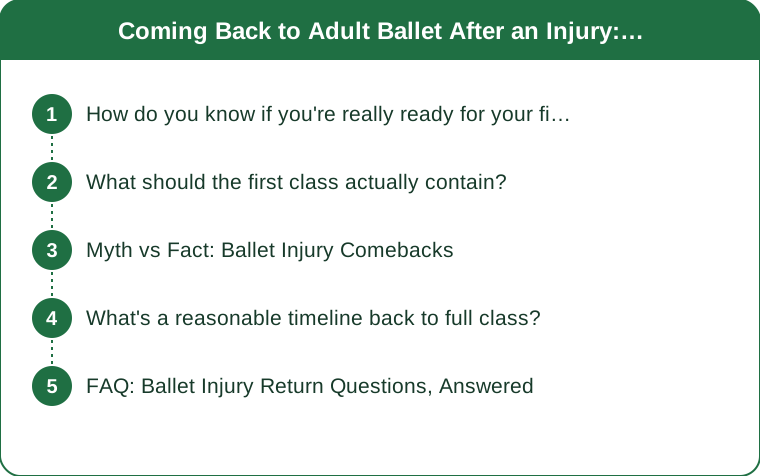
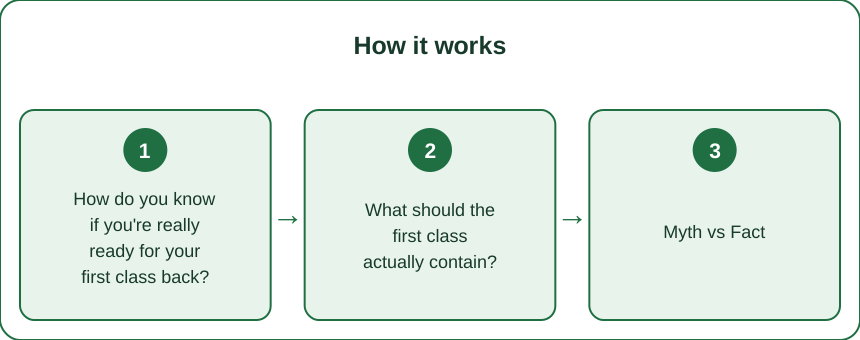
How do you know if you’re really ready for your first class back?
You should be able to do your injured joint’s basic daily movements (walking, stairs, reaching) pain-free for at least a week, not just ‘better.’ If you’re still modifying daily activities around the injury, ballet class is premature — even a gentle barre asks more range and control than most daily movement does.
What should the first class actually contain?
Barre only — skip center and skip jumps entirely, even if you feel strong. Barre gives you a support surface and lets you control range precisely; center work removes both right when your proprioception (body-position sense) is still recalibrating.
Within barre, work at roughly 60-70% of your pre-injury turnout and extension height. This isn’t caution for its own sake — smaller range at first lets you rebuild the neuromuscular pathways without re-triggering guarding patterns.

Myth vs Fact: Ballet Injury Comebacks
Myth: If it doesn’t hurt, it’s fine to push to full range immediately. Fact: Pain-free doesn’t mean fully recalibrated. Proprioception and control often lag behind pain resolution by 2-3 weeks — pushing full range in that window is the most common re-injury window.
Myth: Modifying movements means you’re not really back. Fact: A dancer modifying degré height or skipping jumps for 2 classes isn’t behind — they’re following the actual return-to-sport pattern used in injury rehab generally.
Myth: Time off means you lost your technique. Fact: Technique memory (alignment, musicality) returns fast. It’s tissue capacity and confidence that need the gradual rebuild — not your ballet knowledge.
What’s a reasonable timeline back to full class?
A common, conservative pattern: 2 barre-only classes, then barre plus slow center work for 2 classes, then full class without jumps for 1-2 classes, then full participation. That’s roughly 2-3 weeks for a minor injury, longer for anything requiring a medical clearance.
If pain or swelling returns at any stage, go back one stage rather than pushing through — this is the single most protective habit in a comeback.
FAQ: Ballet Injury Return Questions, Answered
Should I tell my teacher I’m coming back from an injury?
Yes, always, before class starts — a teacher who knows can adjust corrections and combinations for you without singling you out mid-class.
Is it normal to feel anxious about re-injury?
Very common, and it often outlasts the physical healing. Anxiety easing takes its own timeline — pushing through it with reassurance from a professional (PT or doctor) tends to work better than forcing confidence.
When should I see a professional instead of just easing back in?
If you have any lingering swelling, instability, or sharp pain (versus general stiffness), get cleared by a doctor or physical therapist before returning to class at all. This is general information, not medical advice.
TL;DR:
- Be pain-free in daily movement for a week before your first class back
- First class: barre only, 60-70% range, no center or jumps
- Modifying isn’t falling behind — it’s the correct return pattern
- Any pain or swelling returning means step back one stage, not push through
A slower, structured comeback gets you to full class faster and more safely than rushing back at 100%.
Keep Reading
This article is for general informational and styling purposes only. Fit, sizing, and product availability may vary.