Why Your Turnout Stopped Improving - and What Actually Changes It
Quick Answer: Most adult turnout is limited by hip socket shape and femur geometry, which don’t change with training - typically accounting for the majority of your available range. What is trainable is hip external rotator strength, hip flexor and adductor length, and your ability to hold the rotation you already have under load. Working the trainable part usually gains a modest but real amount of usable turnout, and gains far more control.
If you’ve been stretching for a year with nothing to show for it, the problem probably isn’t your discipline. It’s that you’ve been training the wrong third of the equation.
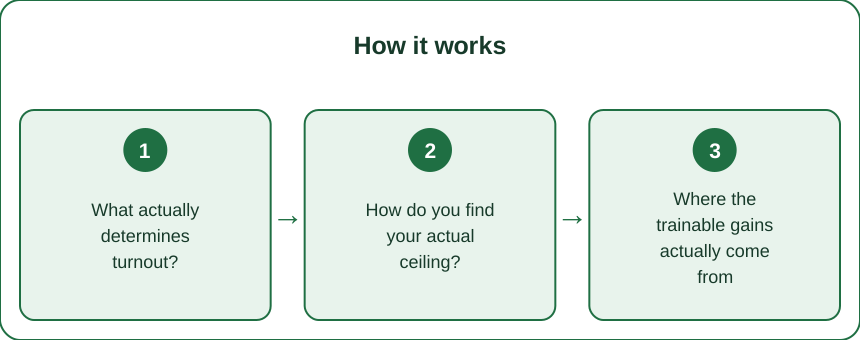
What actually determines turnout?
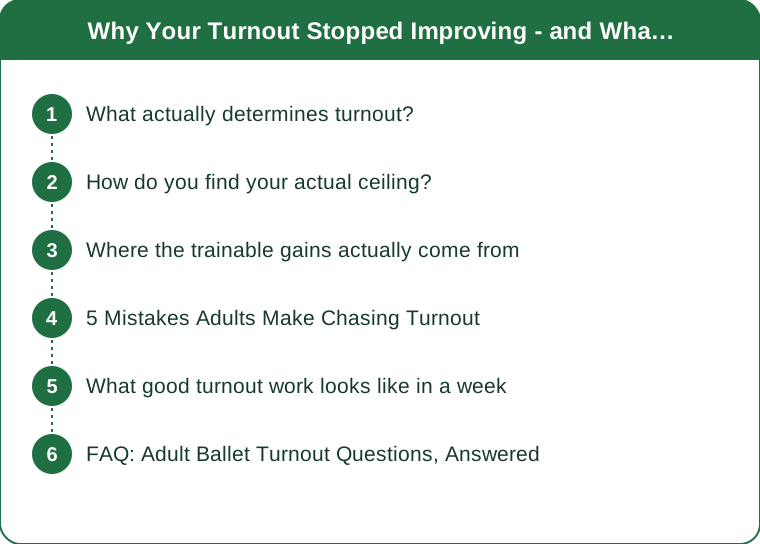
Three things, and only one of them responds to training.
1. Bone geometry (not trainable). The depth and orientation of your hip sockets and the angle of your femoral neck set a hard ceiling on external rotation. This varies enormously between people and is largely settled by adulthood. Two dancers with identical training can have very different maximum turnout for reasons neither of them controls.
2. Soft tissue length (partly trainable). Hip capsule, ligaments, and the muscles that resist external rotation - adductors, hip flexors, and parts of the hamstrings. This responds to consistent work, slowly.
3. Active control (very trainable). The strength of your deep external rotators and your ability to hold rotation while moving, under load, at speed. This is where nearly all the accessible improvement lives for adults.
The most useful distinction in this whole subject: passive turnout versus active turnout. Passive is what someone can move your leg into. Active is what you can produce and hold yourself. Most adult dancers have a gap between the two, and closing that gap looks like better turnout to every observer, including your teacher.
How do you find your actual ceiling?
A simple floor test gives you a workable estimate in two minutes, and knowing the number is genuinely freeing.
The prone rotation check. Lie face down, bend one knee to 90 degrees, and let the lower leg fall outward across your body without letting your hip or pelvis lift. The angle your shin travels approximates your passive hip external rotation on that side.
- Most people find noticeable asymmetry between sides. That’s normal, and chasing symmetry is not the goal
- If your shin barely moves, no amount of frog stretching will change the bone. Your effort is better spent on control and on the rest of your technique
- If it moves well but your standing first position doesn’t match, you have a control gap - and that’s the good news, because control is trainable
Do this test before and after a serious eight-week block, not week to week. Turnout changes on a timescale of months, and weekly checks produce noise you’ll misread as failure.
Where the trainable gains actually come from
Four things, in rough order of return on time invested.
1. Deep external rotator strength. Clamshells and band-resisted rotations are the entry point, but the version that transfers is standing and loaded. Try slow retirés holding rotation against a light band, 3 sets of 8 per side, twice a week.
2. Adductor length and strength. The inner thigh both limits rotation passively and stabilises it actively. Copenhagen-style side planks and controlled adductor work do more for turnout than static straddle stretching, because they build range you can hold.
3. Hip flexor length. A tight rectus femoris and iliopsoas pull the pelvis into a tilt that quietly reduces available rotation. Half-kneeling stretches with the pelvis tucked, 45 seconds per side, before class.
4. Standing on one leg. Almost all turnout that matters in class happens on one leg, and single-leg control is where most adults lose the rotation they had at the barre.
Where the gains don’t come from: sitting in frog pose for ten minutes, having a friend push your knees down, or forcing turnout from the feet by screwing the floor. That last one is the injury risk - turning out from the knees and ankles rather than the hips loads the knee joint in a way it isn’t built for.
5 Mistakes Adults Make Chasing Turnout
1. Forcing the feet to a position the hips can’t hold. If your knees don’t track over your toes in plié, your feet are further turned out than your hips are. This is the single most common cause of knee pain in adult ballet.
2. Stretching cold before class. Long static holds on cold tissue don’t achieve much and can temporarily reduce power. Save the long holds for after class or a separate session.
3. Judging turnout at the barre. The barre is a support that lets you borrow rotation you can’t produce alone. Judge your turnout in the centre, on one leg.
4. Training rotation only in flexion. Frog and butterfly work rotation with the hip bent. Ballet mostly needs it with the hip straight or extended, and the two positions have different limiters. Add standing and prone work.
5. Comparing your first position to a teenager’s. Adolescent bone remodels in response to load in ways adult bone doesn’t. An adult starting at 25 is not a late version of a child dancer - it’s a different project with different available levers, and a genuinely good one.
The third mistake is the one that surprises even experienced adult students: the barre flatters turnout enough that people spend years training a position they never actually have in the centre.
What good turnout work looks like in a week
Modest, frequent, and mostly not stretching. Here’s a realistic structure alongside two classes a week.
Before class (6 minutes):
- Half-kneeling hip flexor stretch, 45s per side
- Banded clamshells, 15 per side
- Standing rotation holds in retiré, 5 slow per side
Twice a week, separate from class (15 minutes):
- Copenhagen side plank progression, 3 x 20s per side
- Prone external rotation with light band, 3 x 8 per side
- Single-leg balance in a small retiré, 3 x 30s per side, no barre
- Long static adductor and hip flexor holds, 60-90s each, at the end only
What to expect: control improvements are noticeable in four to six weeks. Passive range changes, if they come, take three months or more and are usually small. A dancer with modest range and excellent control looks better and is far less likely to get injured than one with generous range and none.
If you get pinching at the front of the hip, sharp knee pain, or clicking with pain, stop and get it assessed. This is general information, not medical advice.
FAQ: Adult Ballet Turnout Questions, Answered
Can adults improve turnout at all?
Yes, but mostly the active component - strength, control, and holding rotation under load. Passive range gains are real but modest, and the bone geometry component doesn’t change.
Is 180 degrees realistic for an adult?
For the large majority, no, and it isn’t a useful goal. Plenty of professional dancers don’t have it either. Usable, controlled rotation at 120-140 degrees looks correct and works for almost all repertoire at recreational level.
Should I use turnout boards or discs?
They’re useful for feedback about where rotation comes from, and risky if used to push past what your hips produce. Use them under a teacher’s eye, not alone at home.
Why is one side always better?
Hip anatomy is routinely asymmetric, plus everyday life is asymmetric. Train both sides equally, expect them to stay different, and don’t let the better side set the standard for class.
TL;DR:
- Bone geometry sets your ceiling and doesn’t change with training
- The trainable part is active turnout: rotator strength, adductor and hip flexor length, single-leg control
- Test passive range prone, then judge active turnout in the centre, not at the barre
- Never turn out from the feet or knees - that’s where the injuries come from
- Control gains show in 4-6 weeks; range gains take months and stay modest
Stop measuring yourself against a number you were never going to reach. Control is what an audience reads as beautiful turnout anyway, and control is the part you actually own.
Keep Reading
This article is for general informational and styling purposes only. Fit, sizing, and product availability may vary.