Your Spotting Is Fine - So Why Does Your Pirouette Still Travel?
Quick Answer: A pirouette travels when your weight is not fully over the supporting leg at the moment you release, when the preparation pushes rather than turns, or when the passe leg pulls you off axis. Spotting controls dizziness and finish, not location - so if you are travelling with clean spotting, look at the preparation, the plie depth, and where your weight sat before you left the ground.
You have been told to spot harder for months and you have been spotting fine for months. The turn still lands you a foot to the left of where you started.

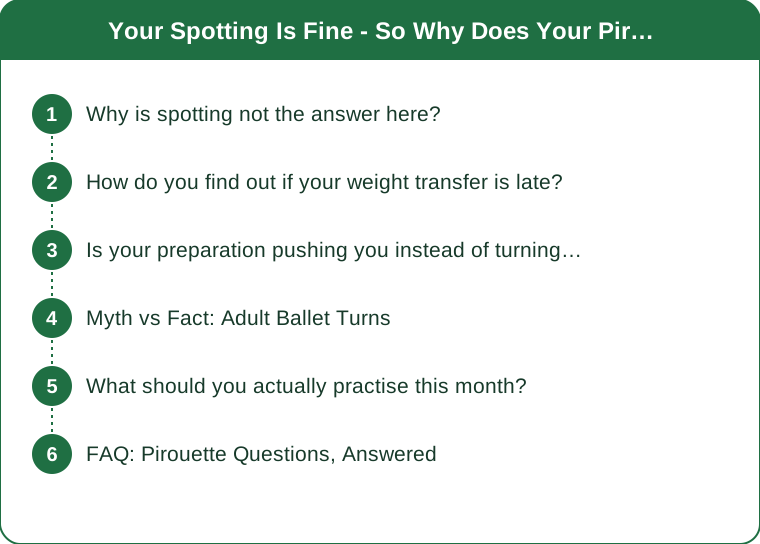
Why is spotting not the answer here?
Because spotting is a head skill, and travelling is a base problem.
Spotting does three real jobs: it reduces dizziness, it keeps you oriented to the front, and it gives you a clean finish. What it does not do is control where your supporting foot is. The head cannot correct a weight distribution error that happened before you rose.
Here is the useful diagnostic. Stand in your preparation and rise to releve without turning at all. Hold five seconds. If you cannot hold a still releve passe on that leg for five seconds without shifting, no amount of spotting will produce a turn that stays put - you are asking the turn to fix a balance you do not have yet.
Most adult beginners can hold it. Which means for most people, the problem is not strength or balance either. It is what happens in the transition between plie and releve - a window that lasts about a fifth of a second and is almost impossible to feel in the moment.
How do you find out if your weight transfer is late?
Slow the whole thing down until the error becomes visible.
The half-speed test. From fourth, plie, then move to releve passe without turning, taking a full two seconds. Watch in the mirror. Does your torso shift sideways over the supporting leg as you rise, or was it already there?
If you see a shift, your weight was still between both feet in the plie, and the rise is doing the transfer. In a real turn there is no time for that transfer, so the momentum finishes it - by moving you across the floor.
The fix is in the plie, not the rise. In the preparation, the majority of your weight should already be over the front leg, with the back leg pressing the floor for rotation rather than holding you up. It will feel wrong at first because it feels like you are about to fall forward.
A useful cue: think of the back foot as a hand pushing a revolving door, not a leg holding you up. Doors get pushed sideways; legs get stood on. Confusing the two is the single most common cause of a travelling turn.
Is your preparation pushing you instead of turning you?
This is the second big one, and it is about direction of force.
Rotation comes from a twist against the floor, not a shove. If your back leg extends straight back and pushes, that force has to go somewhere, and it goes into linear travel. If the same leg presses down and rotates, the force becomes spin.
Things to check in your fourth:
- Is the fourth too big? A long fourth encourages a push. Most adult dancers turn better from a slightly smaller fourth than they think they need.
- Are both heels down in the plie? A lifted back heel has already given away the floor connection that creates rotation.
- Are the hips square? An open back hip turns the push into a diagonal, which is why so many travelling turns drift consistently in one direction.
- Are the arms arriving before or after the rise? Arms that close late drag you off axis; arms that close early kill the momentum. They should arrive as you reach releve.
Consistent direction of travel is the giveaway. Random travel is balance. Always drifting the same way is alignment.

Myth vs Fact: Adult Ballet Turns
Myth: You need more core strength to stop travelling. Fact: Core strength holds a shape you have already found. It cannot place your weight for you. Plenty of strong adult dancers travel, and plenty of less strong ones do not.
Myth: More force in the plie gives more turns. Fact: Beyond a moderate depth, extra plie mostly adds vertical and linear force, not rotational. Dancers who add depth to fix travel usually travel further. Rotation comes from the twist, not the depth.
Myth: Adults cannot learn clean turns without a childhood background. Fact: Turning is a coordination skill with a learnable sequence. What childhood training gives you is thousands of repetitions, and you can accumulate those at any age - just at a slower rate.
Myth: If you spot faster, you turn better. Fact: A head that whips faster than the body creates torque the body has to absorb, often by shifting off the supporting leg. Spotting should be quick and late, not early and frantic.
Myth: Travelling is always wrong. Fact: Plenty of choreography uses travelling turns deliberately. The problem is only travelling when you did not choose to.
What should you actually practise this month?
Three drills, ten minutes, done more often than they are done long.
1. Quarter turns from fourth (5 minutes). Prepare, and turn only 90 degrees to releve passe, hold, and lower. Twenty of these per side. The short rotation means you cannot rely on momentum to hide a weight error - if you are off, you will know instantly.
2. Releve passe holds (3 minutes). No turn. Rise, hold 8 seconds, lower with control. Five per side. This builds the position you want to arrive in, so your body knows the target.
3. Preparation-only reps (2 minutes). Plie in fourth, shift weight forward, feel the back leg pressing rather than holding. Rise to releve on the supporting leg only, no turn, no passe. Ten per side.
Do them before class rather than after, when you are fresh. Three quality sessions a week beats one long one, because this is a motor pattern, and patterns are built by frequency.
Give it four weeks before judging progress. Turning improves in steps, not in a smooth line - people typically feel nothing for three weeks and then something clicks.
FAQ: Pirouette Questions, Answered
Should I look at the mirror or at a spot on the wall?
A fixed spot at eye level on the wall. The mirror invites you to check your position mid-turn, which delays the head and pulls you off axis. Save the mirror for the slow drills.
Why do I turn better on one side?
Almost everyone does. It is usually a combination of hip mobility differences and which side you have unconsciously practised more. Deliberately doing more repetitions on the weaker side narrows it, though rarely to zero.
Is it normal to feel dizzy as an adult beginner?
Yes, and it reduces with practice as your vestibular system adapts. If dizziness is severe, lasts well beyond class, or comes with other symptoms, get it checked. This is general information, not medical advice.
How long until I can do a clean double?
With consistent practice, many adults find a reliable single within a few months and a double within a year or so. The double needs the single to be genuinely stable first - chasing it early is what builds travelling habits.
TL;DR:
- Spotting controls dizziness and finish, not where you land
- Travelling usually starts in the plie, with weight not yet over the supporting leg
- Rotation comes from pressing and twisting the back foot, not pushing back
- Consistent drift in one direction points to alignment, random drift to balance
- Practise quarter turns, releve passe holds, and preparation-only reps three times a week
If you have been told to spot harder for six months and nothing has changed, the instruction was probably right for someone else’s problem. Go back to the preparation, get the weight over the supporting leg before you rise, and let the turn happen from a base that is already where it needs to be.
Keep Reading
This article is for general informational and styling purposes only. Fit, sizing, and product availability may vary.