Plié, Tendu, What Now? The Adult Beginner's Ballet Dictionary
Quick Answer: Ten terms cover most of a beginner adult ballet class. Plié is a knee bend, tendu stretches the foot along the floor, dégagé is a tendu that lifts off it, relevé is rising to the balls of your feet, and passé parks one foot at the opposite knee. Port de bras just means how you carry your arms. Pronounce them badly and keep going — everyone does.
Adult ballet class is roughly 50% movement and 50% a French vocabulary quiz you never studied for.
The teacher says “dégagé” and you confidently dégagé the wrong leg. This is for that moment. Ten terms, zero judgment, maximum chance of surviving Tuesday.
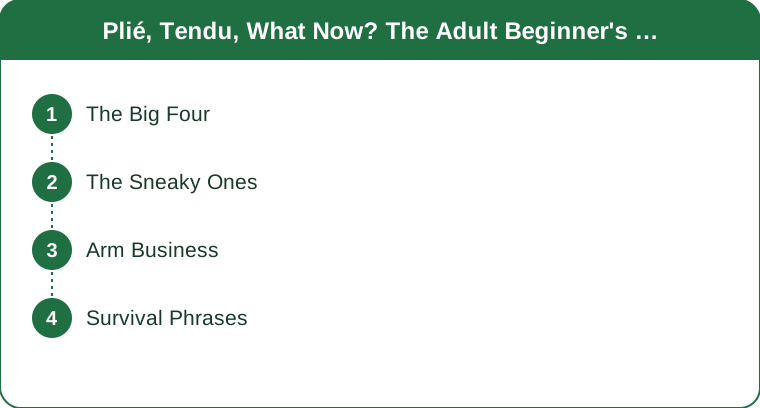
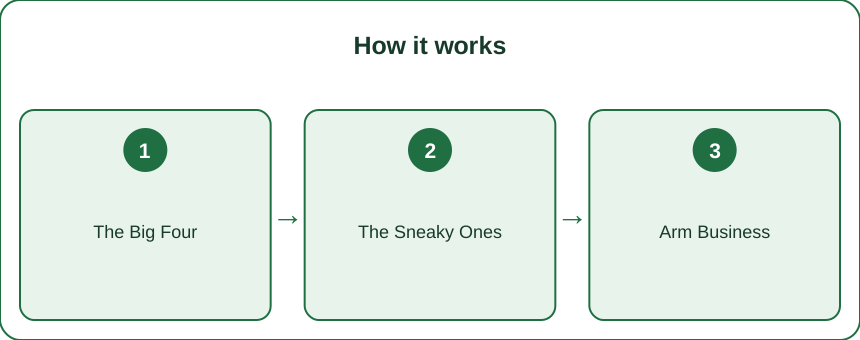
What Are the Four Terms You’ll Hear Most?
These four make up most of the first twenty minutes of any class.
Plié (plee-AY) — bend the knees, keep the dignity. A demi-plié is a half bend with heels down; a grand plié goes deeper and the heels lift in most positions. It’s the first thing at the barre for a good reason: it’s how ballet warms the joints and how nearly every jump lands.
Tendu (tahn-DOO) — stretch the foot along the floor until the toe points, without lifting it. Literally “stretched.” The toe stays in contact with the floor the entire time, which is the part beginners lose first.
Relevé (ruhl-VAY) — rise onto the balls of your feet. Think of it as the elevator arriving. Controlled going up and, more importantly, controlled coming down.
Sauté (soh-TAY) — jump. Both feet leave the floor, and both feet land through a plié. The landing is the part that’s graded, not the height.
Which Ones Trip Everyone Up?
The next tier, where the French stops being self-explanatory.
Dégagé (day-ga-ZHAY) — a tendu that left the ground. Same action, but the foot lifts a few inches at the end. “Disengaged,” which is unnecessarily dramatic for a small movement.
Rond de jambe (rohn duh ZHAHMB) — “circle of the leg.” Your toe draws a semicircle on the floor. Your hip does not draw anything, as your teacher will remind you approximately every week.
Passé (pa-SAY) — the working foot parks at the opposite knee, like a flamingo with formal training. You’ll also hear retiré for essentially the same shape, and no, nobody will explain the difference in a beginner class.
Chassé (sha-SAY) — a gliding step where one foot chases the other. It means “chased.” Once you know that, you’ll never forget it.

What About the Arms?
Port de bras (por duh BRAH) — literally “carriage of the arms.” It sounds like the easy part right up until you try holding a position for a full 90-second exercise and discover muscles you had no reason to know about.
The arm positions are numbered first through fifth, and they’re essentially parking spots for your limbs. First is a rounded oval in front, second is opened out to the sides, fifth is overhead.
You will forget third. Everyone forgets third. There is no shame in this and it is possibly a rite of passage.
The genuinely useful thing to know: your arms are what make the rest look intentional. A wobbly balance with calm arms reads far better than a solid balance with panicked ones.
5 Mistakes Everyone Makes in Adult Beginner Ballet
1. Watching your feet. Looking down collapses your posture and kills your balance, which is precisely the opposite of what you were trying to fix. Eyes forward, even when you’re guessing.
2. Gripping the barre. The barre is a fingertip reference, not a handrail. Holding on hard means your standing leg never learns to do its job — and you’ll notice it the first time you try the center.
3. Forcing turnout from the feet. Turnout comes from the hip, and how much you have is largely anatomical. Cranking your feet outward to fake it puts real strain on your knees. Work with what your hips give you.
4. Trying to get the French right before the movement. Copy the person in front, do the shape, learn the word later. The vocabulary sticks through repetition, not study.
5. Comparing yourself to the teenager in the front row. They’ve been doing this since age six. You started at 34 with a full-time job. Different sport, functionally.
The second one is the one that quietly holds people back for months — a light barre hand accelerates everything.
What Do the Teacher’s Phrases Actually Mean?
A small translation guide for the things that aren’t French at all:
- “And again” — four more times, minimum.
- “Other side” — your bad side, publicly.
- “From the top” — you’ll get it this time, probably.
- “Beautiful!” — you tried, which in adult ballet is genuinely most of the curriculum.
- “Feel the floor” — press down through your whole foot rather than gripping with your toes.
Mini FAQ
Do you need to know French to take ballet?
No. The terms are learned by association — the teacher demonstrates while saying the word, and after a few classes the sound and the shape connect. Nobody expects correct pronunciation from beginners.
What’s the difference between tendu and dégagé?
A tendu keeps the toe on the floor throughout; a dégagé is the same stretch but the foot lifts a few inches off the ground at the end. Dégagé is essentially a tendu that kept going.
Is adult beginner ballet actually beginner-friendly?
Genuinely, yes — most adult beginner classes assume no prior experience and spend the first weeks on the barre basics. Look for classes labelled “absolute beginner” or “adult beginner” specifically rather than “open level.”
TL;DR:
- Plié = bend, tendu = stretch along the floor, dégagé = tendu lifted, relevé = rise, sauté = jump.
- Rond de jambe circles with the toe, not the hip. Passé parks the foot at the knee.
- Port de bras is arm carriage — calm arms make everything else look deliberate.
- Fingertips on the barre, eyes up, turnout from the hip not the feet.
- Copy first, learn the vocabulary later. It sticks through repetition.
Print it, keep it in your bag, and mispronounce everything with confidence. The French is a bonus level, not the game.
Keep Reading
This article is for general informational and styling purposes only. Fit, sizing, and product availability may vary.